
Blog
Tourniquets in Transit: How Long Is Too Long, and When to Convert
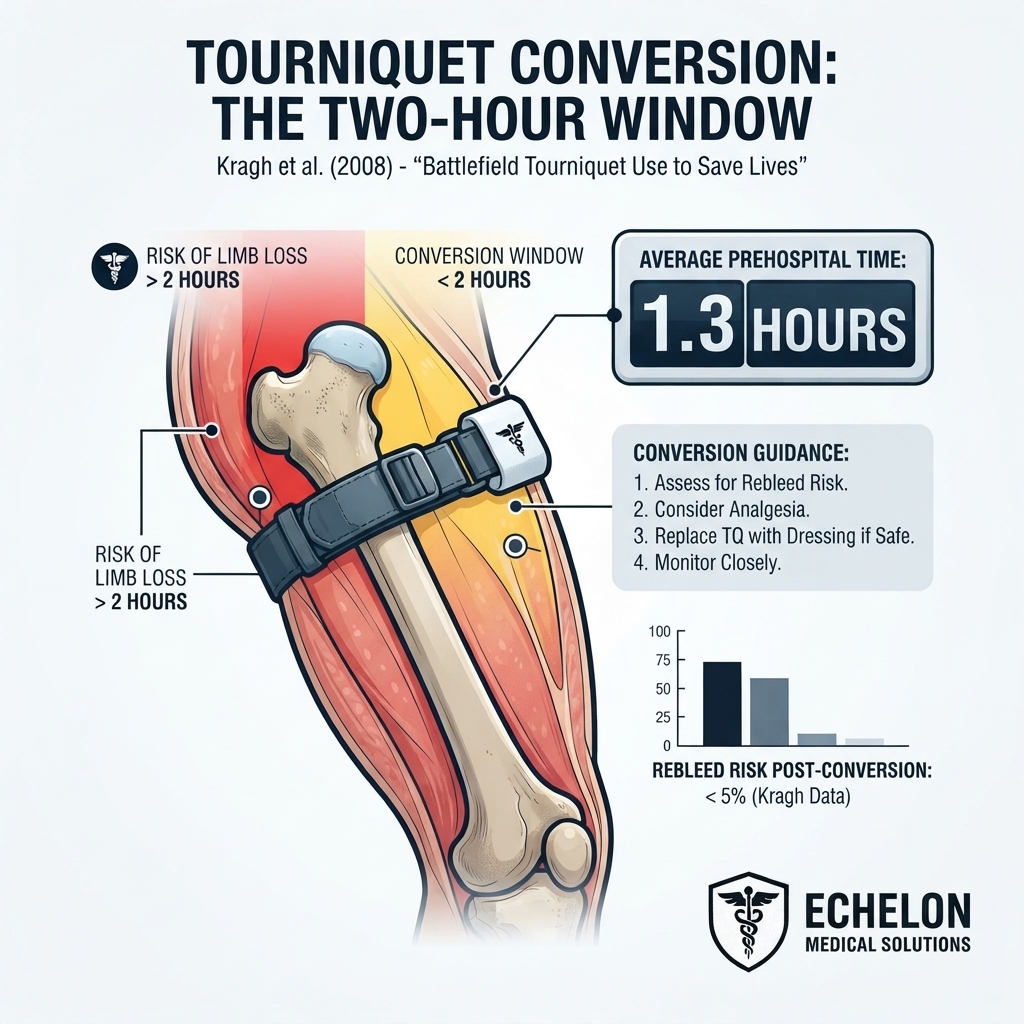
Applying a tourniquet takes less than a minute. Deciding what to do with it over the next ninety minutes is the harder problem. Guidance is clear that a tourniquet saves lives and, when used properly, carries a low risk of lasting harm. It is far less prescriptive about the awkward middle ground: the casualty who is bleeding-controlled but still in transit, with a principal not yet secure and a rendezvous point far away.
What the evidence says about tourniquet safety
The study most often cited is Kragh and colleagues, “Practical use of emergency tourniquets to stop bleeding in major limb trauma”, published in the Journal of Trauma in 2008. It reviewed emergency tourniquet use in combat casualties.
| Measure | Finding |
|---|---|
| Patients | 232, with 428 tourniquets applied to 309 limbs |
| Time tourniquet was on | Median 1 hour; 91% of applications under 2 hours |
| Nerve palsy at the tourniquet site | 4 patients, all described as transient (about 1.7% of 232) |
| Limbs lost because of the tourniquet alone | None reported |
The authors concluded that morbidity was low and that the balance of risk and benefit favoured using tourniquets, provided users had proper training and a suitable device. They also found no association between tourniquet duration and most of the complications they measured.
Notice what the paper does not say. It does not set a two-hour limit, and because most applications in the study were short, it says little about what happens at much longer durations. The data supports “short application times were associated with few problems”. It does not say two hours is a proven safe threshold.
Where the two-hour rule comes from
Two hours appears in current Tactical Combat Casualty Care guidance, but as a planning threshold for conversion, not as a claim from a single study. The Committee on TCCC guidance says every effort should be made to convert a tourniquet to another means of bleeding control in under two hours, if bleeding can be controlled that way. It also sets an outer limit: do not remove a tourniquet that has been in place for more than six hours unless close monitoring and laboratory capability are available.
Treat two hours as a widely used clinical rule of thumb built on this body of evidence and on practice, not as a number any one paper proves.
When conversion is not advised
The same guidance says not to convert if any of the following apply:
- The casualty is in shock.
- You cannot closely monitor the wound for re-bleeding.
- The limb has been traumatically amputated.
- The tourniquet has been on for more than six hours.
- The casualty will reach a medical facility within two hours of application.
- Tactical or medical considerations make it inadvisable.
Read those conditions as a decision aid. Two of them, shock and inability to monitor, are the ones most likely to apply in a moving vehicle or a crowded extraction. If you cannot watch the wound, the safer default may be to leave the tourniquet on and prioritise getting the casualty to care.
The decision in a protection setting
A tourniquet applied in a hurry buys time. It does not stop the clock, and every minute it stays on is a minute you are trading against the limb. In a close protection or convoy setting, three things make the decision harder than it looks on paper:
- Time to care is uncertain. Route changes, traffic and incident scenes stretch the journey.
- Monitoring is difficult. A vehicle in motion, low light and a second task, such as protecting a principal, all limit how closely anyone can watch a dressing.
- The person deciding is rarely a doctor. It is usually whoever is carrying the medical role, working under time pressure and with limited ability to reassess.
A scenario worth rehearsing: the tourniquet is on, the principal is not yet secure, and there are forty minutes to the extraction point. Most people want to convert straight away, but fewer have worked out what they do if conversion fails halfway through the move. Under the guidance above, with the destination inside two hours and monitoring difficult, leaving the tourniquet on is often the more defensible plan. What matters is that the reasoning is agreed in advance, not improvised.
Why writing it down beats deciding on the day
Conversion is a decision made when stress is high and information is thin. A written procedure does three useful things. It removes the need to argue the criteria in the moment. It gives a second person something to check the decision against. And it makes the team think about the bad branch, the failed conversion, before it happens. None of this replaces clinical judgement, but it gives that judgement a structure.
It also helps to decide in advance how the team will reassess. Guidance says conversion should only happen where the wound can be closely monitored for re-bleeding, so a procedure should say who watches, how often and what they do if they see blood.
What a written procedure should cover
- Time of application. Guidance says to mark every tourniquet with the time, using a permanent marker on the device and on the casualty card.
- Who decides. Name the role that makes the conversion call, and who backs them up.
- Criteria. Write the conversion conditions above into the procedure, including the “do not convert” list.
- Estimated time to care. Set a rule for how the team estimates it, and when to revisit that estimate.
- Failure plan. If bleeding restarts after conversion, the tourniquet goes back on, higher and tighter, with a new time noted. Rehearse that step.
- Handover. Pass the application time, any conversion attempt and any drugs given to the receiving clinicians.
This article is general education. Tourniquet use and conversion should be learned in a practical, accredited course, and your procedures should be agreed with a suitably qualified clinician.
Does your team have a written answer for tourniquet conversion mid-evacuation, or is it a judgement call nobody has put on paper? Tell us in the comments on our LinkedIn page what your procedure says, or ask whoever owns your medical planning.
To discuss medical readiness training or planning for your team, get in touch with Echelon Medical Solutions at operations@echelonmedicalsolutions.com.
Sources
- Kragh et al., Practical use of emergency tourniquets to stop bleeding in major limb trauma. J Trauma, 2008
- Kragh et al. 2008, full text copy used to check the figures above
- Committee on TCCC / Joint Trauma System guidance, Tactical Field Care hemorrhage control (2022 version, as reproduced)
Study figures were checked against a full-text copy of the paper; the guideline text is a reproduction of the 2022 version, so check the current official Joint Trauma System guidelines before adopting any procedure.