
Medical staffing
Executive medics: what they do, and why details carry one
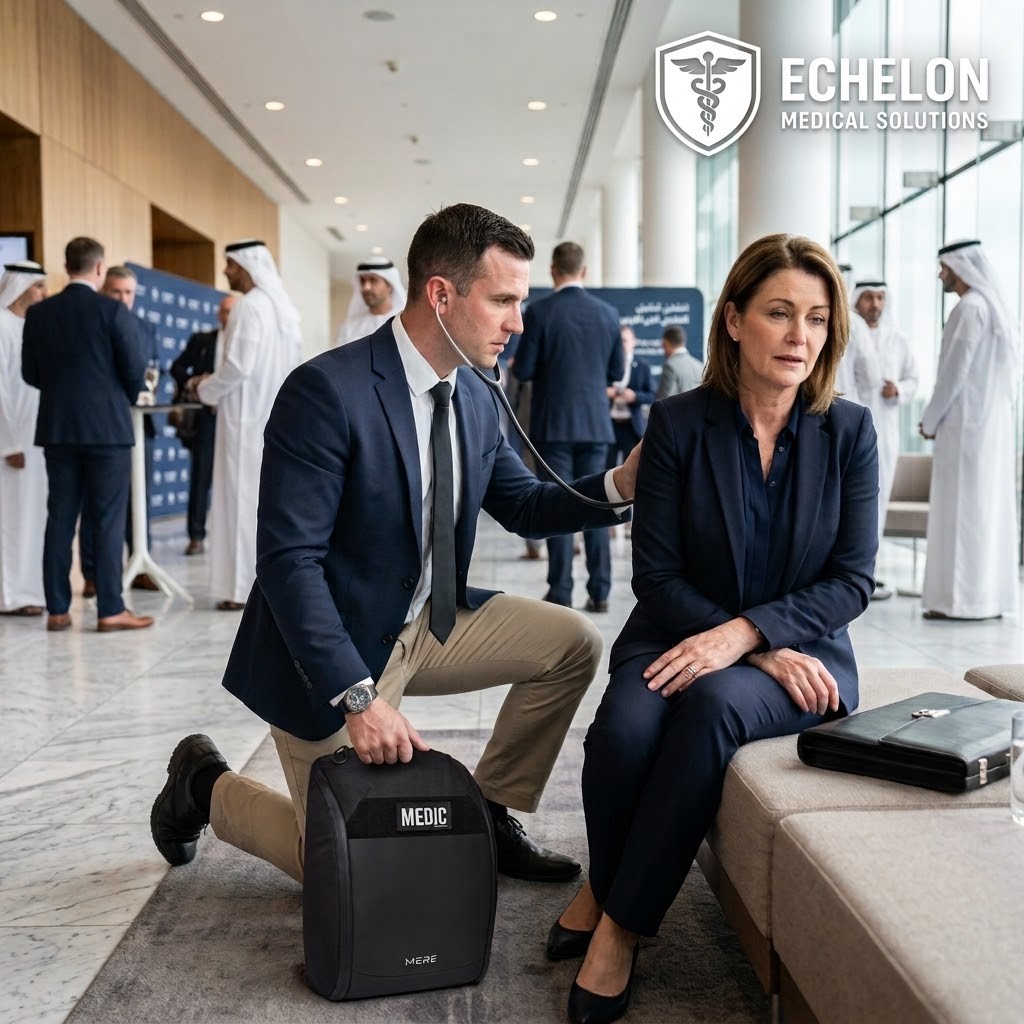
On most days on most details, the real medical risk to a principal has nothing to do with the threat picture. It is a cardiac event at altitude on a long flight, a reaction to something on a menu in a city the team does not know, a fall, a diabetic emergency, or a road traffic collision in a country where the ambulance response is measured in tens of minutes and the receiving hospital is not one you would choose.
The executive medic is the person who has planned for those days as well as the exceptional one.
What the role is
An executive medic, sometimes called a close protection medic or EP medic, is a clinician who travels with or is attached to a protective detail. Usually a paramedic or EMT with extra training in working discreetly inside a security team. The job has three parts, and the first two carry most of the value.
- Plan. Before any movement, the medic builds a medical plan for the trip: the principal’s history and medications, the medical threats specific to the destination, the nearest credible definitive care and how to reach it, and what happens if that plan fails.
- Prevent. On the ground, the medic manages the boring risks. Hydration, fatigue, food and water, medication timing, altitude, and the early signs of illness before they become an incident on a schedule that does not allow for one.
- Respond. If something happens, the medic is the clinical lead on scene, with a kit matched to the tasking, until the casualty is handed to a hospital or a retrieval service.
Why not just call an ambulance
Because the assumption behind “call an ambulance” does not hold everywhere a principal travels. In some places the response is slow, the vehicle is under equipped, or the nearest hospital is not where you want to be treated for what has happened. An embedded medic closes that gap. They start definitive standard care immediately, and they worked out where the patient actually needs to go before anyone needed to know.
The kit, and the governance behind it
An executive medic’s kit is built for the specific trip: airway and breathing support, haemorrhage control, cardiac monitoring, drugs appropriate to their scope and the jurisdiction, and the consumables to hold a patient for the realistic evacuation time.
Behind the kit sits clinical governance. A defined scope of practice, medical direction, drug authorities, documentation. A medic operating on their own judgement in another country needs a framework, not just a bag. If a provider cannot show you that framework, be careful.
When it is worth it
Not every trip needs a dedicated medic. It becomes worth it when the principal has a significant medical history, when travel is to a location with weak medical infrastructure, when the itinerary is remote or high tempo, or when a mishandled medical emergency would be a serious operational and reputational problem.
We scope this per tasking, and that includes telling a client when a full time medic is not the proportionate answer and a solid medical plan plus one trained team member will do the job.